












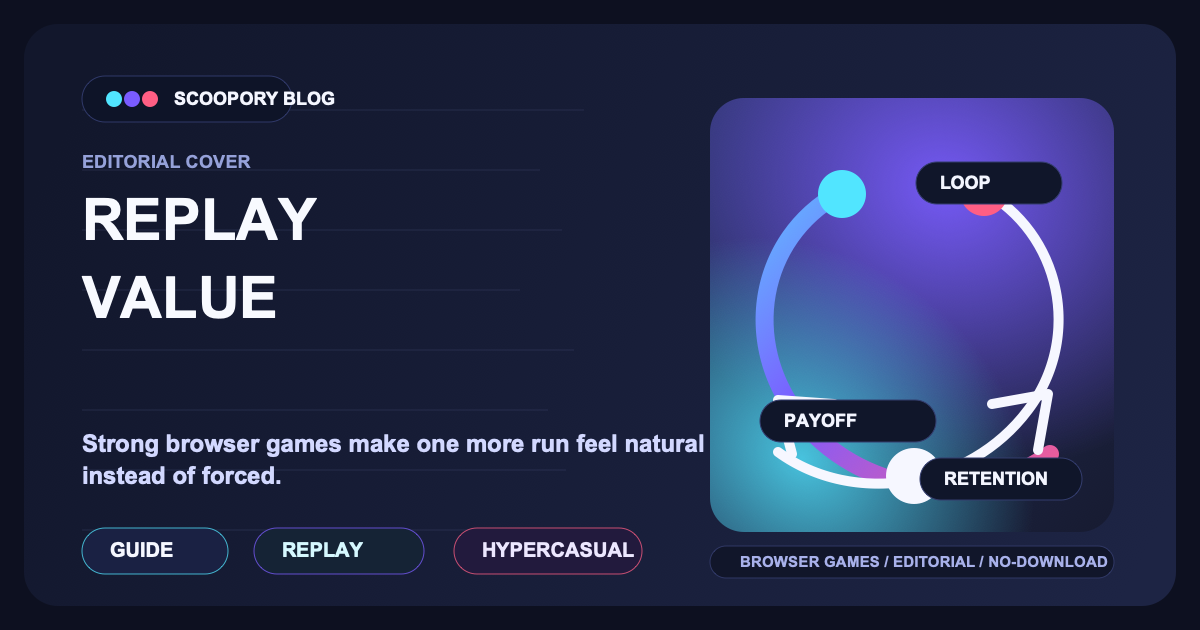
How to Tell if a Browser Game Is Worth a Second Run
A second run is the real quality test for browser games. Browser games are quick to open, but that speed helps only if your selection method is disciplined. The strongest sessions usually come from short, explicit filters rather than spontaneous clicking. When you choose based on session length, input comfort, and pressure tolerance, your first game is more likely to hold attention and your second game is more likely to improve on the first.
This guide is for players who often enjoy a first attempt but feel no reason to continue, including casual users and competitive beginners. The goal is not to overanalyze every page. The goal is to remove weak options early and keep only the games that give clear feedback, reliable controls, and useful replay value in the time window you actually have.



Use a practical evaluation order
If a game deserves a second run, it should reveal one clear improvement target after failure. Without that signal, replay becomes accidental rather than intentional. Treat this as a sequence, not a checklist you run once at the end. Run one attempt, note the highest-risk weakness, then run a second attempt to confirm whether the issue is design or just adaptation time.
- Actionable Failure: Loss should explain what to change next run.
- Micro Mastery: You should feel one small skill gain quickly.
- Consistent Controls: Input consistency is mandatory for meaningful replay.
- Visible Variant: Second run should differ through layout, speed, or pressure.
- No Dead Time: Downtime between runs should stay minimal.
Game examples you can open right now
Use concrete examples instead of abstract theory. These links give you a fast comparison set so you can test the same criteria across different loop styles in minutes, not hours.
- Bridge Race Test of Precision: good for testing improvement through repeated attempts.
- Bucket Crusher ASMR: useful when you want low-friction replay.
- BouncingBall: reveals whether second-run rhythm improves.
- Tap Tap Racing: clear feedback loop for shot precision.
- Tap Tap Racing: pressure test for consistent control behavior.
Where category navigation improves the result
After one or two runs, jump from individual games back to category level. The most useful hubs for this topic are Arcade Games, Hypercasual Games, and Arcade Games. You can open the full categories index to pivot faster by mood, then use blog guides to confirm decisions around difficulty, controls, and session pacing.
A simple routing pattern works well: category choice first, two fast game tests second, then one short guide review for tie-breaks. That pattern reduces random churn, especially for beginners and casual players who do not want to spend the whole break searching.
Common mistakes that waste short sessions
- Confusing novelty with replay value.
- Ignoring unclear death states that block improvement.
- Accepting delayed controls because first run looked flashy.
- Staying in a game with long restart friction.
Quick pre-play checklist
- Second attempt has a clear goal.
- You can explain the prior mistake.
- Input timing remains consistent.
- Restart happens quickly.
- Motivation grows after run one.
If a game misses two checklist items in the first two runs, switch immediately and keep momentum. Better results on Scoopory come from fast replacement, intentional category pivots, and steady use of internal links. You do not need perfect information before playing; you need a consistent method that protects your limited time and makes each next click more accurate than the previous one.